A few months ago, the History welcomed a guest post by Dr Gillian Williamson with her groundbreaking research into John London, to date the earliest known Black voter in Britain, who lodged his vote in the 1749 by-election for Westminster. In this latest post, Dr Robin Eagles explains the potential discovery of further Black voters taking part in the same contest and subsequent polls in Hertfordshire.
In July 1739, the General Evening Post reported the death of a Mr Kent at his house near Seven Dials. According to the paper, Kent occupied the post of chimney sweeper of the king’s palaces ‘a place of considerable profit’. Replacing him was one Mr Fatt and both men were described as ‘Blackmoors’ [an outdated term indicating Black heritage]. The role would have involved ensuring the upkeep of the chimneys at royal residences in London, such as St James’s Palace. Intriguingly, Treasury accounts from 1714 suggest that the holder of the post at that time was Anne Fatt, suggesting that the family had held the role before, under Queen Anne, and had now regained it, under George II.
Eighteenth and nineteenth-century commentators were often snide about chimney sweeps. The nature of their profession meant that they were frequently derided for being ‘unclean’, and this sometimes led to them being described as black, or depicted in prints with black skin. Consequently, some caution needs to be used when identifying a sweep’s heritage. However, the fact that the paper used the specific term ‘Blackmoor’ seems indicative of the fact that this was not a case of people being dealt with slightingly because of perceived uncleanliness.
One of the weekly essays in the Scots Magazine for February 1740 noted the ‘Promotion of Mr Fat [sic] the Chimney-Sweeper’, and also employed terminology describing his heritage directly, which appears to confirm the identification. Making reference to a vacancy in one of the Cornish boroughs, the author suggested that he hoped to see Fatt promoted to Parliament, before remarking that the presence of a Black Member of the Commons might give rise to racist abuse. [Scots Magazine, ii. 56] A later essay, in the Oxford Magazine for 1770, also referred to Fatt as the only ‘Black-a-moor’ ever to have held a place at Court. [The Oxford Magazine or Universal Museum, v. 59]
The commentary surrounding Fatt’s appointment offers valuable insights into attitudes to the Black population of Britain in the period. It is interesting that a potentially lucrative contract was held in succession by Black British businessmen; also, that Fatt’s good fortune was the subject of comment in major periodicals. The reports help to add layers to our understanding of the composition of London society at the time. They show that members of the Black population were able to develop affluent careers, but also that their success was remarked upon, and not always favourably.
Fatt’s striking, if not wholly unusual, surname has also led to the likely identification of new voters. A decade after Fatt took over as sweep to the royal palaces, a by-election was held in Westminster after one of the constituency’s Members, Granville Leveson Gower, Viscount Trentham (later marquess of Stafford) accepted a place in government. Under the rules of the day, he was obliged to seek re-election, on this occasion triggering a contest after Sir George Vandeput, bt. chose to challenge for the seat. The initial result saw Trentham returned with 4,811 votes to Vandeput’s 4,654. Following a scrutiny, the numbers were revised down but Trentham still emerged with 4,103 votes, comfortably ahead of Vandeput, who was left with 3,933 votes.
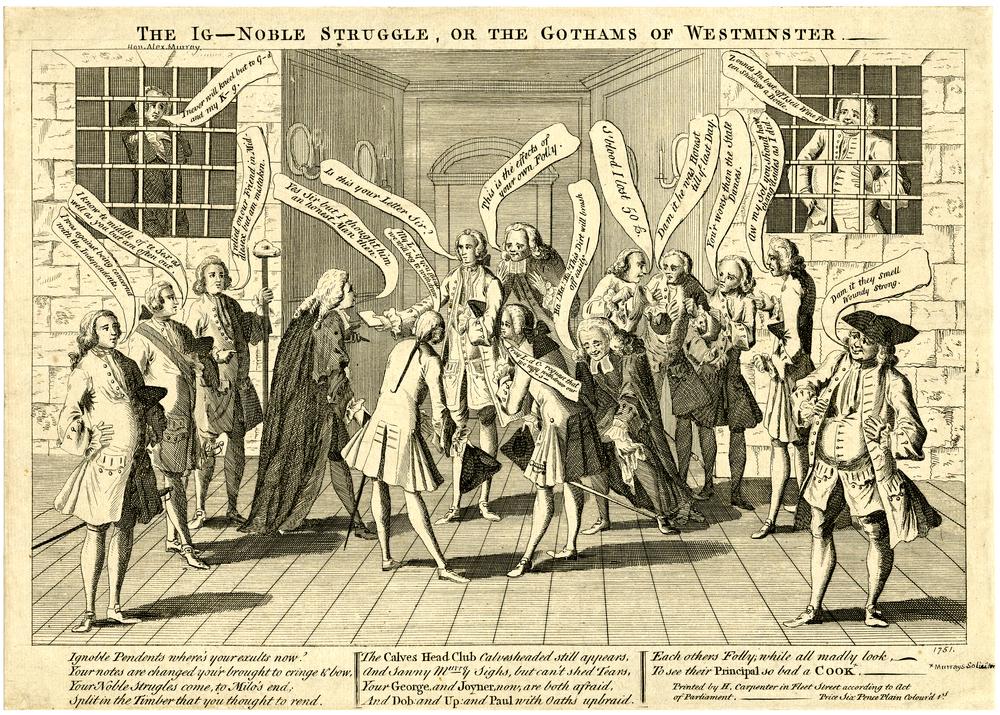
According to the poll book, one of those voting for Trentham was William Fatt, who was identified as a ‘chimneysweeper’ from Pye Street in the parish of St Margaret and St John. As such, he was one of five men involved in the trade (one of them noted as a Chimney Doctor, rather than sweep), voting in the election. Although more work is needed to confirm the finding without doubt, it seems highly credible that this was the same man who, ten years earlier, had taken on the role of sweeper of the royal palaces. Assuming this to be the case, he thus joined John London as a second Black voter participating in the election.
Fatt’s name is not unique and unravelling the details of the family is complex. Two individuals, both named William Fatt, wrote wills in the 1770s, which were proved within three years of each other. It seems most likely that the first William Fatt, by then described as being of Castle Street, in St Giles in the Fields, whose will was proved in 1773 [TNA, PROB 11/984], was the man appointed to sweep the royal palaces in 1739 and who voted in the 1749 poll, even though the document makes no mention of a trade. This William Fatt referred to a daughter, Mary Knotgrass, which calls to mind the appearance in legal records from 1760 of William (a soot merchant from Swallow Street) and George Fatt (a victualler from Great Earl Street, Seven Dials), who stood bail of £40 each for Peter and Mary Nodgrass [sic]: possibly they were her brothers as William’s will mentioned four sons: William, George, Henry and Thomas.
The second William, almost certainly son of the elder William, died on 9 April 1776. He was buried in St Martin in the Fields, where a memorial was erected to him, his wife (Martha) and to sons-in-law, Thomas Angell (d. 1780) and another named Freeman. His will gave his trade as a chimney sweep, indicating a continuation of the family business. [TNA, PROB 11/1022] It referred to a house in Hampton, Middlesex, which he left to his daughter Mary, along with property at Sharrett (Sarratt) in Hertfordshire, which he left to another daughter, Anne. Both places also featured in the will of William the elder. Execution of the will was deputed jointly to Mary and to a carpenter from Piccadilly, named James Filewood, who received £10 for his trouble. By coincidence, Filewood also featured in the 1749 Westminster poll book.
The Hertfordshire property seems to have offered both William (the younger) and George Fatt further opportunities to vote. Both names appear in the 1774 poll book for the county. William, noted again as resident of Swallow Street, but also a householder in Sarratt, voted for William Plumer and Viscount Grimston. George Fatt, noted of London, but claiming rights as a householder at Great Gaddesden, also voted for Grimston but, unlike William, gave his other vote to Thomas Halsey. George Fatt then featured in the subsequent poll for the county in 1790. This time, he plumped for William Hale, who failed to be returned.
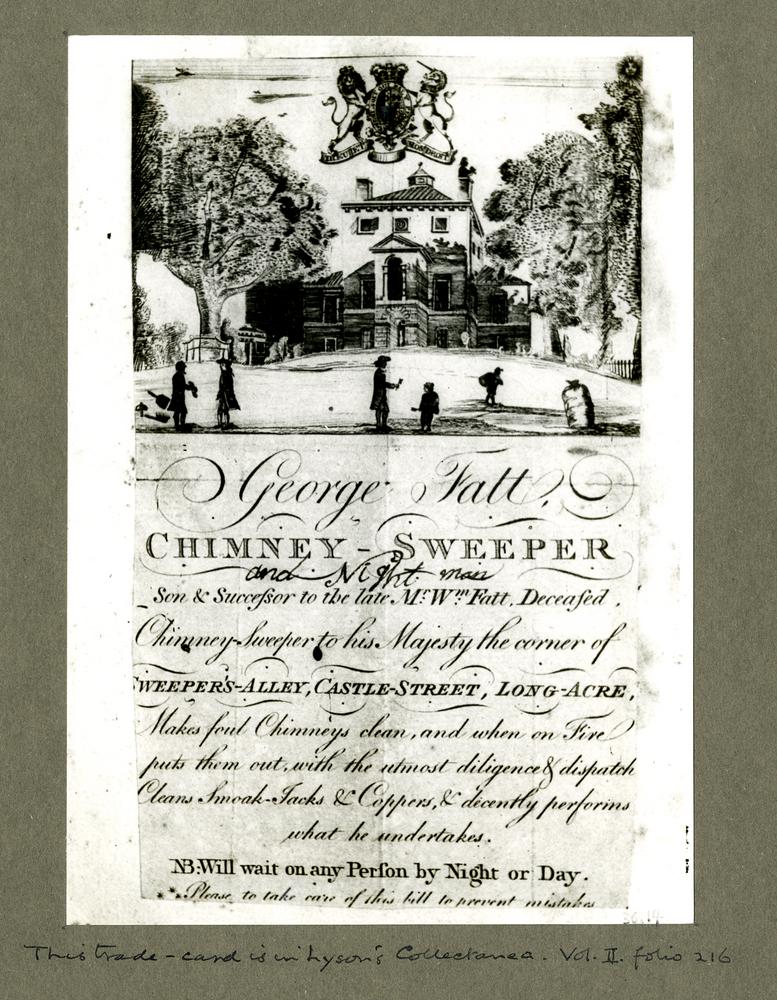
That the family business endured beyond the lives of the two Williams is indicated by the existence of a trade card from 1780 describing George Fatt as son of William and continuing the sweeping business from Sweeper’s Alley, Castle Street, Long Acre. It also noted that he had retained the role as sweeper to the king. George Fatt’s success in doing so appears to have been in spite of the efforts of ‘a great officer’, who had attempted to install his own porter in the role on William’s death. According to the press, ‘P.D.’ complained of the appointment of the man, who had been chosen in spite of knowing nothing of the business of chimney sweeping. [Morning Chronicle, 19 Apr. 1776]
This brief snapshot into the successful establishment of a family business, by people of Black heritage, is just a minor glimpse into the lives of Londoners in the eighteenth century. More work needs to be done to determine beyond doubt the family’s story. However, the findings suggest that there were many more people like them (and John London): successful business operators, who took the trouble to lodge their votes in eighteenth-century parliamentary elections.
RDEE
Further Reading:
Benita Cullingford, British Chimney Sweeps: Five Centuries of Chimney Sweeping (2001)