In the latest post for the Georgian Lords, Dr Robin Eagles examines an unpleasant incident that took place in Oxford in the 1740s, which left a college servant dead and several high profile students under suspicion of his murder…
In April 1784, George Nevill, 17th Baron Abergavenny, was approached to ask whether he would accept promotion to an earldom. In the wake of Pitt the Younger’s success in the general election, it was time for debts to be repaid and right at the front of the queue was John Robinson. Robinson had formerly worked for Lord North as a political agent but had chosen to switch his allegiance to Pitt and put all of his energy into securing Pitt a handsome victory. Robinson’s daughter was married to Abergavenny’s heir, Henry, so the new peerage would ensure that Robinson would ultimately be grandfather to an earl.
Abergavenny had also made a political journey. Married back in the 1750s to a member of the Pelham clan, he had naturally found himself within the orbit of the Old Corps Whigs and then of the Rockinghams. A consistent opponent of North and his handling of the American crisis, he had distanced himself from the former Rockinghamites who had entered the coalition with North and ultimately helped to bring the Fox-North administration down. So, the earldom was a double reward.
It might all have been very different, as exactly 37 years previously, while a student at Christ Church, Oxford, Abergavenny had narrowly avoided being tried for murder.
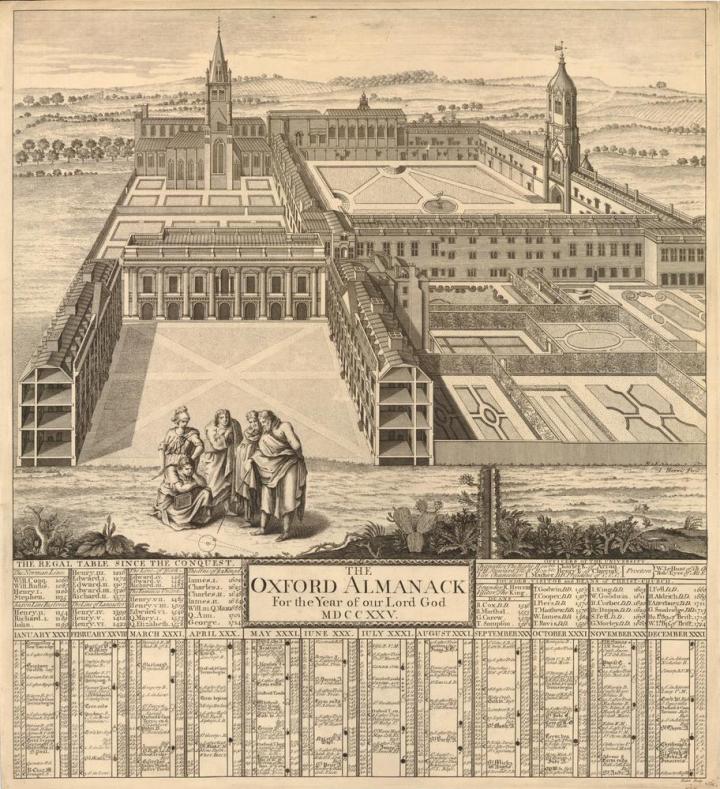
The story, as told in the press and in private correspondence, was that one of the Christ Church scouts (servants) named John or William Franklin (the papers could not agree which) had been found early in the morning of 4 April 1747 in one of the college quadrangles, badly bruised and with a fractured skull. His hair had been shaved and his eyebrows burnt off. There were also tell-tale indications of him having been very drunk.
What appeared to have happened was that a group of students, one of them Claudius Amyand, had been holding one of their regular shared suppers in their rooms, but had decided to entertain themselves by making Franklin, who seemed to have had a reputation as being somewhat eccentric, extremely drunk. The regular attendees had taken the prank (as they viewed it) so far, but things had become more extreme when they were joined by others, who had not been part of the original group. The newcomers were Abergavenny, Lord Charles Scott, a younger son of the duke of Buccleuch, Francis Blake Delaval and Sackville Spencer Bale (later a clergyman and domestic chaplain to the 2nd duke of Dorset). They appear to have handled Franklin very roughly – making fun of him by shaving his head – and to have left him so drunk that he was utterly incapable. According to Frederick Campbell, Abergavenny and Scott retreated to their own rooms at this point, leaving it to the remainder of the party to drag Franklin ‘out to snore upon the stair-case’. [Hothams, 42]
It was unclear what happened next, but it was assumed that after being abandoned on the stairs, Franklin had fallen down, fracturing his skull. On being discovered in the morning, Abergavenny’s valet took Franklin home, where he was examined by a surgeon, but nothing could be done for him. That there may have been a more sinister explanation for his injuries was, however, indicated early on by the news that most of those believed to have taken part in the drinking session had fled, and it was gossiped that the two most responsible for his injuries had been Abergavenny and Scott. [Ward, 169]
Certainly, the coroner’s jury considered that there had been foul play and brought in a verdict of ‘wilful murder by persons unknown’. Some observers took a different view. Frederick Campbell reckoned that it had been a joke that had been carried too far and he was certain that none of those in the frame would ever be convicted. He also added that ‘there was not three of the jury but was drunk’. [Hothams, 42] Horace Walpole’s sympathies, unsurprisingly, were also with the students, commenting: ‘One pities the poor boys, who undoubtedly did not foresee the melancholy event of their sport’. He had nothing to say about the unfortunate Franklin, who had lost his life. [Walpole Corresp, xix. 387] The only one of the group who seemed to have played no role in what had happened to Franklin was Amyand, who had quit the supper party early.
Had Abergavenny been charged with murder, he would have been able to apply to the House of Lords to be tried before them, in the same way that had happened to Lord Mohun in the 1690s and was to happen again soon afterwards to Lord Ferrers and Lord Byron.
In the event, there was no need for Abergavenny to face the prospect of a trial in Westminster Hall. While the coroner’s jury had concluded that Franklin’s death had been murder, the grand jury that sat on the case during the summer assizes refused to bring in the bill triggering a trial. The grand jury was said to have been made up of some of the principal gentlemen of the county and to have deliberated for several hours before reaching their decision. No doubt they were reluctant to agree to a trial of students from gentry (or noble) backgrounds, but they may also have been swayed by the convenient death of Lord Charles Scott just a few weeks before the assizes, which left the proceedings lacking a key witness (or a likely defendant).

Whatever his role had been, Abergavenny walked away unscathed. In 1761 he applied to be recognized as Chief Larderer at the coronation of George III and Queen Charlotte, and in 1784 he had his status enhanced with promotion to the earldom. Blake Delaval was also able to cast off whatever opprobrium had attached to him, and just two years after Franklin’s death stood for Parliament for the first time (unsuccessfully). He later represented Hindon and Andover and in 1761 was made a knight of the Bath. What happened, truly, on that night in April 1747 was never discovered and justice for Franklin – or at least a full explanation of what had happened to him – was never achieved.
RDEE
Further reading:
The Hothams: being the chronicles of the Hothams of Scorborough and South Dalton…, ed. A.M.W. Stirling (2 vols, 1918)
Horace Walpole’s Correspondence (Yale edition)
W.R. Ward, Georgian Oxford: University Politics in the Eighteenth Century (Oxford, 1958)
General Advertiser
Whitehall Evening Post
