Dr Simon Payling of our Commons 1461-1504 project explores the career of the early Tudor figure Sir Gilbert Talbot, who in service of Henry VII was rewarded with a commissioned painting from Raphael…
When the Tudor antiquarian, John Leland, visited the Shropshire church of Whitchurch in the 1530s, he saw the tomb of Sir Gilbert Talbot, a ‘knight of fame’, and noted, with apparent approval, that Talbot had brought the bones of his grandfather, the great soldier, John Talbot, earl of Shrewsbury, from Castillon, where he had fallen in 1453, for reinternment in the church. Sir Gilbert did not have a career to compare with that of his famous ancestor; none the less, despite the disadvantage of being a younger son, he was a notable servant, as soldier, administrator, and diplomat, of three Kings, Edward IV and the first two Tudors. Such future success had appeared improbable in his boyhood. His father, John Talbot, earl of Shrewsbury, had fallen in the Lancastrian cause in the battle of Northampton in July 1460, when Gilbert was about nine years old. Fortunately for the family, however, the new Yorkist King, Edward IV, was content for their lands to pass to Gilbert’s elder brother, another John, and, in the early 1470s, both brothers found places in Edward’s service, with the young Gilbert becoming one of the King’s cupbearers.
Gilbert’s career began in earnest with his elder brother’s death in June 1473 – in the mysterious words of Leland, ‘not without suspicion of poison’ – leaving as his heir a son, George, only five years old. This made Gilbert the effective head of the family during a long minority. As such, he led a retinue in the invasion of France in 1475, his first known military experience in what was to prove a long military career. He also advanced himself materially by marriage to a wealthy widow, as younger sons of leading families often did. In 1477 he married Elizabeth, widow of Thomas, Lord Scrope of Masham, and daughter of Ralph, Lord Greystoke, lord of the extensive lordship of Wem, about nine miles from the Talbot manor of Whitchurch.
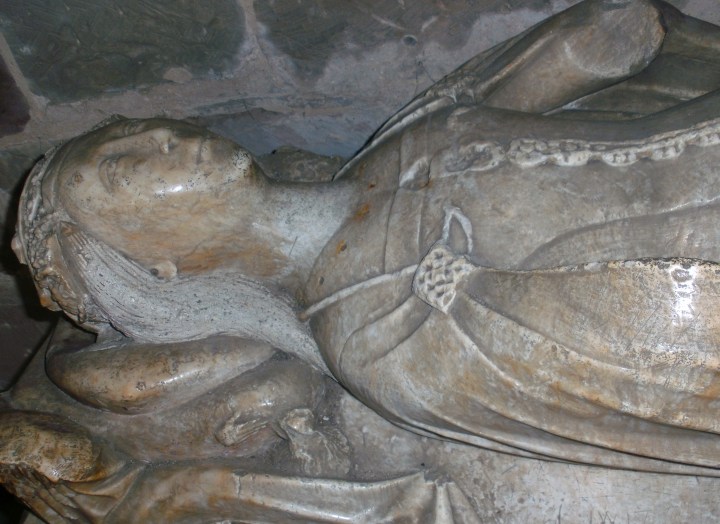
Sir Gilbert had his first wife, Elizabeth Greystoke, who died in 1489, commemorated by a fine monument, still extant, in the church of Bromsgrove (Worcestershire), in which parish Grafton lay. Her own association with the place had been very brief, little more than two years, and her husband’s decision to commemorate her there suggests that he already intended Grafton, which he held by royal grant, to be his family’s long-term home.
Talbot’s prosperity was threatened by the deposition of Edward V. He and the new King, Richard III, clearly distrusted each other. There was one obvious point of tension between them. Talbot’s stepson, Thomas, the new Lord Scrope of Masham, had been brought up in Richard’s household, and Talbot had every reason to consider this personal connexion a threat to his own wife’s interest in the Scrope lands. Probably more significant, however, was a more nebulous consideration. In constructing his title to the throne, the new King relied on the story of Edward IV’s alleged pre-contract with Gilbert’s paternal aunt, Eleanor, widow of Sir Thomas Butler of Sudeley (Gloucestershire). She had died in 1468, when Gilbert was only in his late teens, but there can be little doubt that the Talbots knew the truth (or otherwise) of the story. In this context, Gilbert can only have interpreted his removal from the Shropshire bench and the loss of his stewardship of the Talbot lordships of Blackmere and Whitchurch as evidence of the King’s hostility.
His response was to return to his family’s earlier Lancastrian allegiance and enter communications with Henry Tudor. According to an admittedly rather doubtful source, The Song of Lady Bess, an early-modern narrative poem, there was a crucial meeting on 3 May 1485 at which he, alongside Tudor’s stepfather, Thomas, Lord Stanley, and others, firmly committed themselves to supporting Tudor. This story may be wrong in detail, but Talbot was certainly one of the first men of substance to join Henry after he landed at Milford Haven on the following 7 August. According to the Tudor chronicler, Polydore Vergil, he brought 500 men to Henry at Newport, about seven miles from the Talbot manor of Shifnal. He then went on to command the vanward of Henry’s army at the battle of Bosworth, where he was knighted.
Sir Gilbert’s reward was a place in the new King’s household, and, much more importantly, a grant of an inheritable estate in the valuable Worcestershire manor of Grafton. These rewards were justified by further military service, both at home and abroad.
He fought for Henry at the battle of Stoke on 16 June 1487 and was there created a knight banneret. In June 1489 he was one of the commanders of the army, under the lieutenant of Calais, Giles Daubeney, Lord Daubeney, which repelled a Franco-Flemish force besieging the town of Diksmuide, some 50 miles to the east of the English garrison; and, in 1492, he joined with much of the political nation in the bloodless invasion of France. His military distinction was recognised in 1495 when he was admitted to the Order of the Garter, and he was again in arms in the autumn of 1497 to resist the unthreatening landing of Perkin Warbeck in Cornwall. Later his status as soldier and courtier brought him an ambassadorial role. In February 1504 the King sent him to Rome to offer congratulations to the new Pope, Julius II, and to invest Guidobaldo da Montefeltro, duke of Urbino, with the Garter. The duke rewarded this service by commissioning Raphael, a native of Urbino, to paint an image of St. George adorned with the Garter, for presentation to his fellow Garter knight.
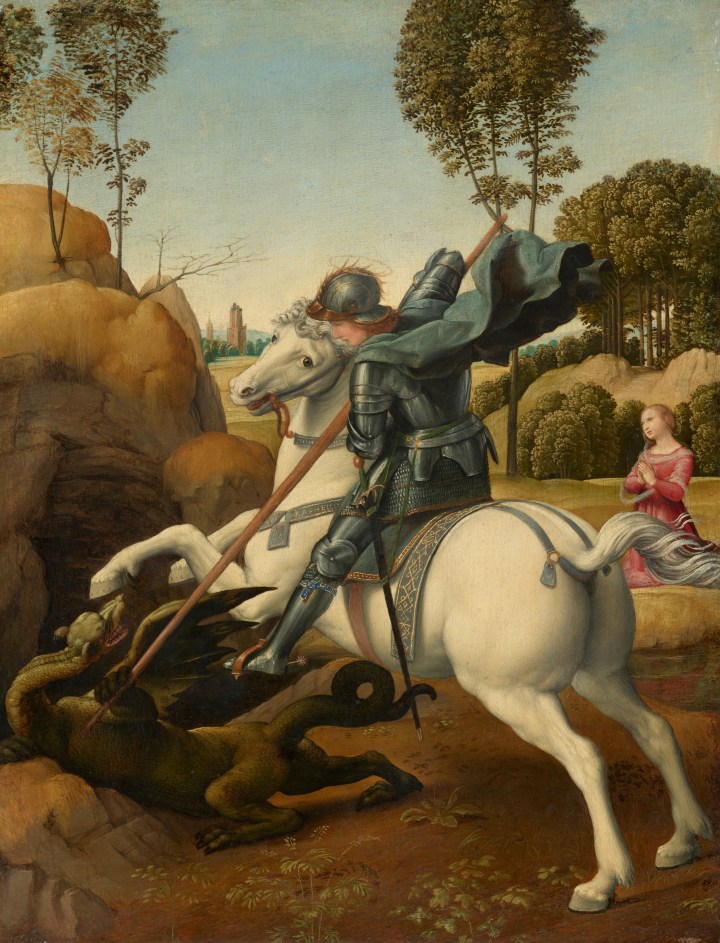
The saint bears the blue garter on his leg with the word ‘Honi’ , the first word of the Order’s motto.
Not long after Sir Gilbert’s return from Rome, he was appointed as deputy-lieutenant of Calais, where he remained, on and off, for the remainder of his life. As such, he took part in the 1513 invasion of France, commanded by his nephew, George, earl of Shrewsbury. A tantalising reference suggests that his service came at great personal cost. On 11 July it was reported that, during the siege of Thérouanne, some 30 miles south of Calais, the French artillery had done ‘great hurt’ to the besieging English camp. Talbot is said to have lost a leg and the chamberlain of the royal household, then Charles Somerset, Lord Herbert, to have been killed. In respect of Somerset’s death, the report was wrong, but it is possible that Talbot, who relinquished his Calais office soon afterwards, was severely injured.
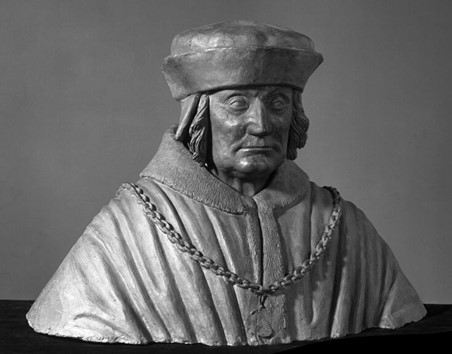
Bust of Sir Gilbert Talbot, Pietro Torrigiano (d.1528) © Victoria and Albert Museum, London
Modelled either when he was in Rome in 1504 or when the sculptor was in England in the 1510s. It remained at his manor house at Grafton, at least until 1710 when much of the house was lost to fire.
On his death in August 1517, Sir Gilbert had an elaborate funeral, costing about £175, equivalent to the annual income of a substantial gentry family, before internment at Whitchurch (his tomb was lost when the church collapsed in 1711, rather ironically the year after his manor house at Grafton burnt down). He died a very wealthy man, in part because of the rewards of royal service but also because of his own entrepreneurial spirit. His second wife, the widow of a London alderman and mercer, Richard Gardener, gave him an entrée into an élite commercial world, and he became a major wool merchant. In the inventory taken on his death, his most valuable possession single possession was the store of wool he had at Calais, appraised at as much as £1850. In the longer context of the history of the comital family of Talbot, his successful career and his consequent establishment of a robust junior branch had great significance. In 1618 his great-great-grandson, George, succeeded his childless fourth cousin, Edward Talbot, as earl of Shrewsbury.
SJP