Dr Simon Payling, of our Commons 1461-1504 section, explores the theme of extreme weather in medieval chronicles.
It is a familiar theme in medieval chronicles, whether monkish or secular, that extreme weather, natural disaster or even just unusual events were, or, at least, could be interpreted as, manifestations of divine interaction with the temporal world. At the most extreme, they were seen as expressions of God’s displeasure, as punishment for some recent transgression. The chronicle of Henry Knighton (d.c.1396), a monk in Augustinian abbey of St. Mary, Leicester, provides a diverting and unsubtle example. He writes, with strong disapproval, of a recent and remarkable development. In the late 1340s troops of women, sometimes as many as 50, had taken to travelling to tournaments, riding on fine horses and ‘dressed in men’s clothes of striking richness and variety’. These women, disparagingly described as, ‘hardly of the kingdom’s better sort’, ‘wantonly with disgraceful lubricity displayed their bodies’. From Knighton’s point of view, however, the story had a happy ending: God ‘had a marvellous remedy to dispel their wantonness’, visiting great storms upon them (Knighton’s Chronicle, ed. G.H. Martin, p. 93). Such specific connexions were, however, rarely drawn. Much more commonly, extreme events were seen as portent rather than punishment, as predictors of some upcoming misfortune in human affairs. Curiously, one of these concerns Parliament. The Monk of Westminster relates that, on 1 February 1388 near Abingdon, the bed of the Thames was empty of water for the length of a bowshot and remained so for an hour, ‘conveying a striking omen of events that were to follow’. He then, although without making the connexion explicit, describes in detail the violent and disturbing events of the ‘Merciless Parliament’ that began two days later (Westminster Chronicle, ed. L.C. Hector and B.F. Harvey, p.234).
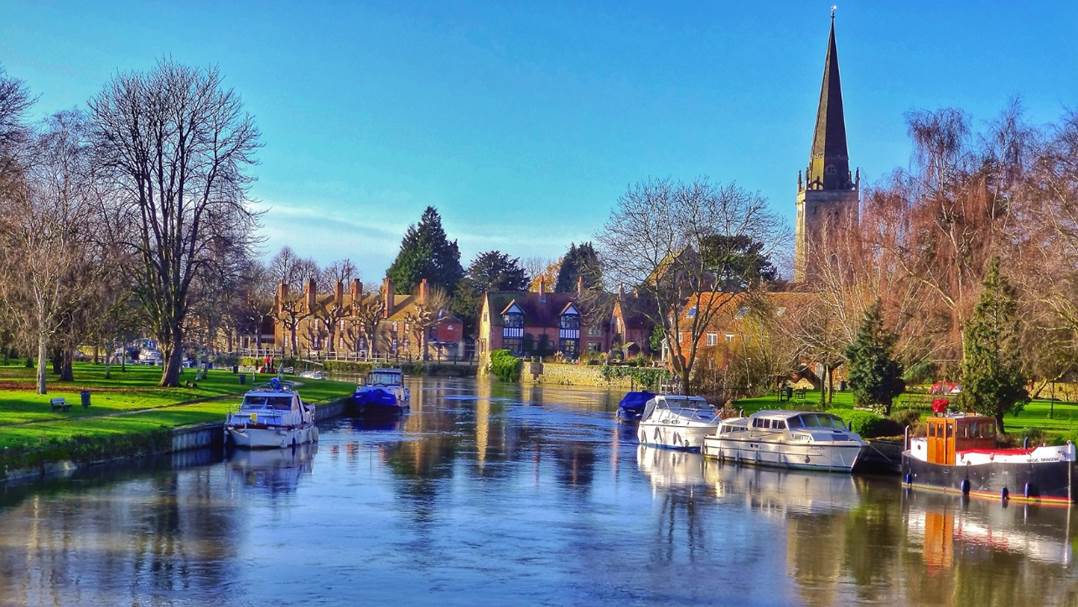
The Thames is said to have dried up on 1 February 1388.
Such examples could be multiplied, but it is worth asking whether the chroniclers were as credulous and unthinking as they appear to the modern observer. One may doubt whether the Monk of Westminster really believed that a lack of water in the Thames was a predictor of grave parliamentary events, the juxtaposition looks more like a literary device to relate human to natural events. He was usually content simply to describe the most extreme natural phenomena free of the overt implication that they were omens. He was not moved to speculate even on the meaning of the ‘amazing marvels’ seen in Cheshire on 1 August 1388 when ‘the heavens were seen to open and angels carrying lights to flit about in the air’. This far-from sinister apparition encapsulates a difficulty chroniclers had in interpreting omens. Imaginatively, within the thought processes of the time, it was just about coherent to see some grave natural disasters as a harbinger of some more general crisis in human affairs; it was less easy (or at least chroniclers were less ready) to see some positive natural event, like the apparent appearance of angels, as portending some happy one. Thomas Walsingham, the most sophisticated of the monastic chroniclers of the late-medieval period, overcame this difficulty by offering both positive and negative interpretations. His account of two major political events shows his interpretative ingenuity. He reports that, as Anne of Bohemia arrived at Dover in December 1381 (for her marriage to Richard II), a sudden ‘disturbance of the sea’ caused the ship she had come in to be dashed to pieces, just after its passengers had safely alighted. Not surprisingly, perhaps, some thought this a forecast of future misfortune; others, however, took the view that it ‘showed the favour of God and presaged future happiness for the land’. Walsingham concluded that, ‘Subsequent events will show why it was a dark, perplexing omen of doubtful meaning’ (Chronica Maiora, ed. D. Preest, pp. 170-1). The same duality is apparent in his account of another event. Although Henry V’s coronation took place in the spring, Walsingham reports that, to everyone’s surprise, there was a great fall of show. Some feared that this harsh weather presaged an unhappy fate, for the new King ‘would be a man of cold deeds and severe in his management of the kingdom’; but others believed it to be the ‘best of omens’, predicting that the new King ‘would cause to fall upon the land snowstorms which would freeze vice and allow the fair fruits of virtue to spring up’ (p.389).
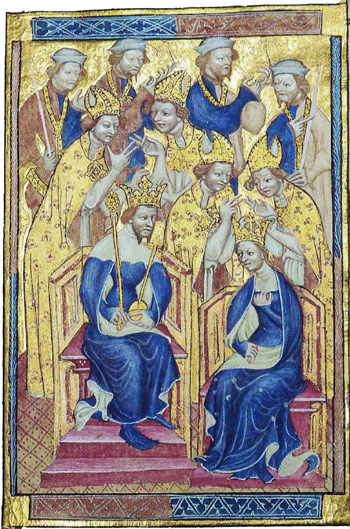
Walsingham reports that the ship on which Anne arrived in England in December 1381 was, immediately after his disembarkation, dashed to pieces by a sudden and great ‘disturbance of the sea’.
On this evidence, one must wonder whether these monastic chroniclers believed that portents, as manifestations of divine intervention in the real world, could be meaningfully discerned. Although Knighton seems to have thought that God was ready to punish female jousters by visiting storms upon them, this was an isolated expression of a belief in God’s active intervention. Like the Monk of Westminster, he was generally content to report extreme natural events, like a fatal heatwave in Calais in August 1347, without seeking to draw any lessons from them. Walsingham, although clearly ready to believe in portents, was so playful in his interpretation of them as to reduce them almost to meaninglessness. Characteristically, he could also employ them as expressions of his own prejudices. He was hostile to the Welsh rebel leader, Owain Glyndwr, and was thus happy to report the ‘dreadful omens’ that were said to have attended his birth, namely that his father’s stables became flooded with blood. Prejudice of a different sort probably informed Knighton’s story of the female jousters. He did not really believe that they were punished by God; he was rather claiming divine endorsement for the sexual and social prejudices of the cloister.
S.J.P.