Dr Simon Payling, of our Commons 1461-1504 section, explores the political allegiance of the Shropshire town of Shrewsbury during the Wars of the Roses.
While, during the Wars of the Roses, the political allegiances of individual noblemen are relatively easy to determine, those of individual towns are generally obscured. This is not surprising, for the notion of the corporate allegiance of a town is a difficult one. While sometimes a few leading townsmen can be identified as active partisans of either York or Lancaster, that does not mean that they carried their fellow townsmen with them. Town authorities generally saw the safest course in giving their allegiance, outwardly at least, to whichever faction happened to be in charge. None the less, if commitment was not actively sought, it could not always be avoided. Towns in areas of strong Yorkist or Lancastrian lordship, or else on the route of campaigning armies, could find themselves drawn into conflict. Shrewsbury provides an instructive example. Already the location of a major battle – when Henry IV defeated the Percys in 1403 – it was, geographically and politically, poorly placed to avoid involvement in the Wars of the Roses. Not only was it one of the major towns on the Welsh March (and, in the townsmen’s own characterization, ‘on off the keyes for the good ordre off the marches’) and a crossing point on the River Severn, it was also in the political orbit of Henry VI’s leading opponent, Richard, duke of York, whose great castle of Ludlow lay only 30 miles away.
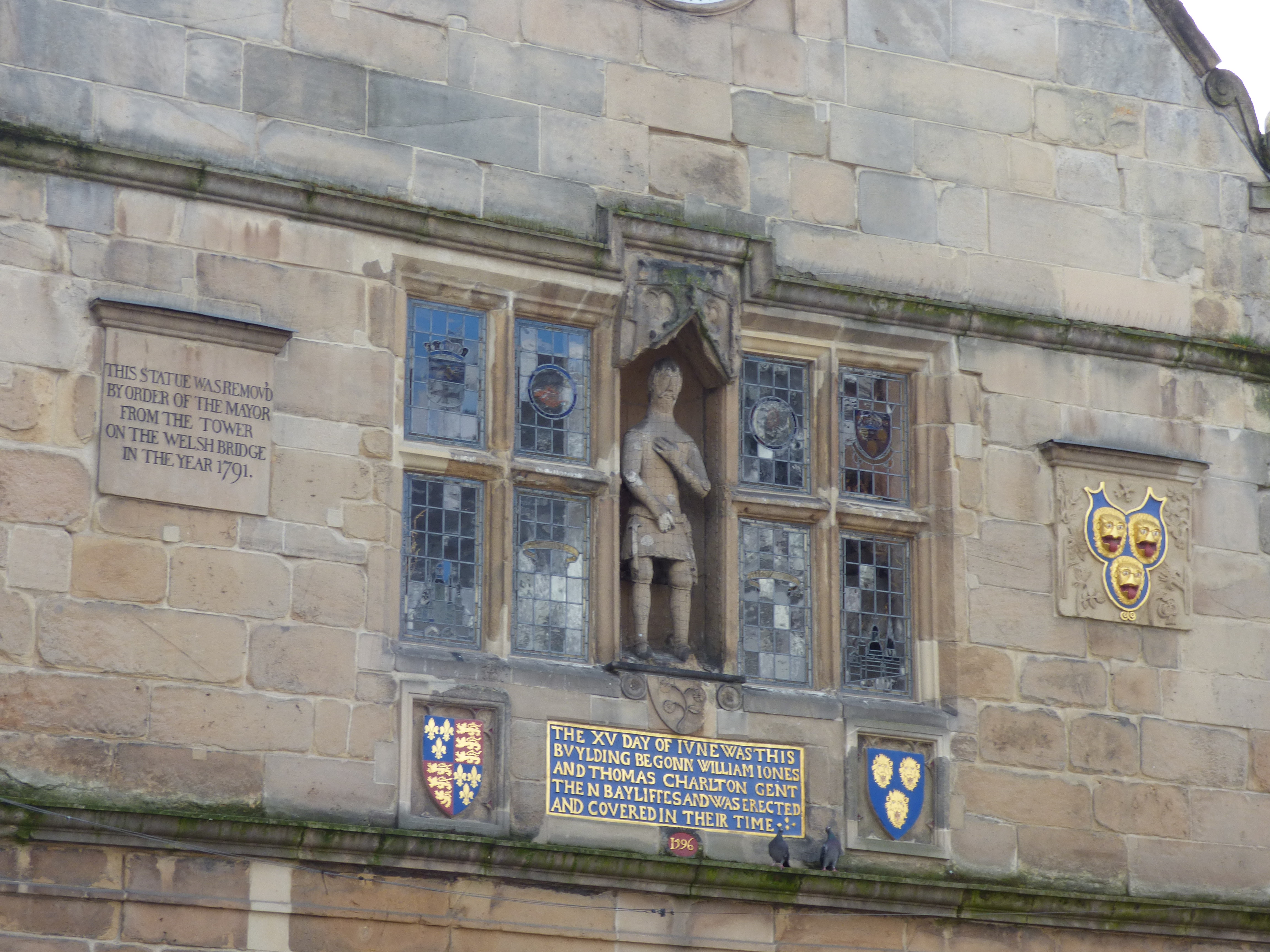
© “Old Market Hall – Shrewsbury Square – statues and sculptures” by Elliott Brown, CC BY-SA 2.0
What this meant for the town was clearly illustrated in the early 1450s. When York returned from Ireland in the autumn of 1450 to claim what he saw as his rightful place in Henry VI’s government, he passed through the town on his way to Westminster and was elaborately entertained by the borough authorities, who provided a pipe (about 100 gallons) of red wine. Although so relatively modest a gift can hardly be interpreted as an endorsement of his opposition to the Lancastrian regime, the duke himself clearly believed that the town was a promising source of support. On 3 February 1452 he wrote, from his castle of Ludlow, to his ‘right worshipful friends, the bailiffs, burgesses and commons of the good town of Shrewsbury’, outlining his grievances against the King’s chief minister, Edmund Beaufort, duke of Somerset and asking the townsmen ‘to come to me with all diligence … with as many goodly and likely men as ye may’. The townsmen responded: some 60 of them, headed by an alderman, Roger Eyton, were later indicted for armed insurrection against the King at Ludlow. If, however, is an early mark of the town’s Yorkist sympathies and its readiness to support rebellion, that readiness, perhaps diminished by the ignominious failure of the 1452 rising, was much less apparent when York again raised rebellion in the Marches in 1459. The bailiffs’ accounts reveal a state of some confusion amongst the town’s leaders, as they dispatched emissaries to detect the movement of rival armies, but that confusion was resolved in favour of Lancaster In the aftermath of the Yorkist defeat at nearby Ludford Bridge, the victorious Henry VI wrote to them thanking them for resisting the passage of the Yorkist Edward Bourgchier, younger son of Viscount Bourgchier, Clearly, at least a faction among the townsmen saw the value of maintaining allegiance to the ruling house, and that faction was still in the ascendant at the time of the battle of Northampton in the following July when the town sent 61 men to fight for Henry VI.
Yet, although the borough authorities were ready to support the ruling house in the first part of the civil war of 1459-61, some senior townsmen had a very different inclination. Chief among them was Eyton, who was in the duke’s ranks at Ludford Bridge, and then fled with him to Ireland, but there were others. An action sued in the court of King’s bench in the Hilary term 1460 implies the existence of a strong Yorkist faction: Edward, prince of Wales, and other Lancastrian lords sued an action of trespass against Eyton, John Horde, head of the town’s principal family, and three other prominent burgesses. The subject of the action is unknown – it disappears from the plea rolls with the change of regime – but there can be little doubt that it arose from some event in the Ludford campaign.
In these circumstances, it is not surprising that this Yorkist faction took control of the town after the Lancastrian defeat at Northampton. The duke of York, as he again made his way back from Ireland in the aftermath of that victory, was welcomed as he had been ten years earlier; and the town then spent £30 on dispatching 40 soldiers to fight for him in the campaign that led to his death on the field of Wakefield, a markedly greater sum than the £8 13s. 4d. spent on the troops it sent to fight for Lancaster at Northampton. Further, as the duke travelled north to his death, his son, Edward, earl of March, making ready for a campaign in the Marches, spent Christmas in Shrewsbury, receiving a payment of 40 marks from the town’s authorities for his ‘good lordship’. Although evidence is lacking, there can be little doubt that there was a Shrewsbury contingent at the earl’s victory at the battle of Mortimer’s Cross, fought about 35 miles south of the town, in the following February, as there certainly was at the battle of Towton some eight weeks later. It is not known how much was spent on sending soldiers to that decisive battle, beyond 16s. 8d. spent on a banner, but £20 was expended on sending 40 soldiers to the new King when he was at Bristol in early September 1461. The bailiffs’ account for 1462-3 records larger payments, with as much as £68 5s. laid out on the wages of soldiers sent to the King in the north and 10s. on another banner, presumably displaying the town’s arms, to be borne before its contingent.
Thus Shrewsbury, in the civil war of 1459-61, conformed to a common pattern amongst towns, namely giving outward allegiance to the ruling house, but there can be little doubt that the sympathies of the townsmen lay with the house of York. In the aftermath of the Yorkist seizure of government in the summer of 1460, they supported York with much greater enthusiasm than they had supported Lancaster in the immediately preceding period. Further, although the town as a corporation was to gain little from Edward IV’s accession (beyond the routine confirmation of its charters), the leaders of the Yorkist faction in the town were rewarded, most notably Eyton, who found a place in the new King’s household and was granted the constableship of the town’s royal castle.
SJP
Further reading:
For a discussion of the misattributed statue: D.R. Walker, ‘An Urban Community in the Welsh Borderland: Shrewsbury in the Fifteenth Century’, University of Wales, Swansea, Ph.D. thesis, 1981, pp. 412-17.
For biographies of Roger Eyton and John Horde with a general discussion of the town in Henry VI’s reign, see L. Clark (ed.), The House of Commons, 1422-61 (Cambridge: Cambridge University Press, 2020).